
Best Exercises for Heart Health: A Complete Guide to Stronger Cardiovascular Fitness

Table of Contents
| Section | What You’ll Learn |
| Does Exercise Actually Lower Blood Sugar? | How movement connects heart and metabolic health |
| Cardio vs Weights: Which Wins for Blood Sugar Control? | Why aerobic and resistance training work differently |
| What HIIT Does to Blood Sugar — and When It Makes Sense | Where high-intensity training fits into a heart-health plan |
| Does the Timing of Your Workout Affect Blood Sugar? | How workout timing can affect glucose and exercise habits |
| How CGM Turns Exercise Research Into Personal Data | What wearable glucose data can and cannot tell you |
| What’s the ‘Best’ Cardio Workout? | The most useful cardio choices for different fitness levels |
| How to Get the Most Out of Home Workouts | How to build an effective routine without a gym |
| Safety Considerations and Injury Prevention | How to exercise safely and progress intelligently |
| Frequently Asked Questions | Clear answers to common heart-health exercise questions |
Does Exercise Actually Lower Blood Sugar?
Your heart does not work in isolation. It responds to what happens throughout your body, including your muscles, blood vessels and metabolism. That is why exercise and blood sugar belong in a broader discussion about cardiovascular health. Regular physical activity improves cardiorespiratory fitness and helps your body regulate glucose, blood pressure, body weight and blood lipids. The NHLBI notes that regular activity strengthens the heart and improves its ability to pump oxygen-rich blood throughout the body.
For people with type 2 diabetes or prediabetes, movement can be especially valuable. During activity, contracting muscles increase glucose uptake and use glucose for energy. Over time, regular training can improve insulin sensitivity and help the body handle glucose more efficiently. These metabolic effects matter because high glucose, high blood pressure and abnormal cholesterol can all contribute to cardiovascular risk.
The important distinction is that heart health should not be reduced to one glucose number. Blood glucose is only one piece of the cardiovascular puzzle. Your blood pressure, cholesterol profile, fitness level, waist circumference, smoking status, sleep and overall activity pattern also influence risk. A routine that improves several of these areas at once can therefore offer more value than an exercise chosen for one isolated measurement.
Consider someone who starts with a 20-minute brisk walk after years of sitting. At first, the workout may feel modest. Yet that session raises heart rate, recruits large muscles and adds meaningful movement to the day. Over several weeks, the person may walk farther with less effort. That improvement in fitness is itself a useful sign that the cardiovascular system is adapting. The best exercises for heart health usually begin with something manageable enough to repeat.
Cardio vs Weights: Which Wins for Blood Sugar Control?

The cardio vs weights debate sounds like there must be one winner. In reality, your heart benefits from combining different forms of training. Aerobic exercise challenges the cardiovascular system for sustained periods. Resistance training challenges muscles against an external or bodyweight load. Johns Hopkins describes both as important components of a complete heart-health program.
Cardio includes brisk walking, cycling, swimming, jogging, rowing and similar activities. These forms of cardio exercise can improve aerobic capacity and circulation while helping manage several cardiovascular risk factors. Regular moderate or vigorous activity can lower blood pressure and triglycerides while supporting healthier body weight.
Strength work adds a different stimulus. Resistance training can preserve or increase muscle mass while improving physical function and body composition. The American Heart Association’s scientific statement reports that resistance exercise can benefit cardiovascular risk factors and can safely complement aerobic exercise in adults with and without cardiovascular disease.
The same principle applies to cardio vs strength training for metabolic health. Muscle contractions increase muscle glucose uptake, while regular resistance work can support glucose regulation and physical independence. More muscle also gives you greater capacity for everyday tasks. Carrying groceries, climbing stairs and getting out of a chair become easier when your muscles are stronger. That combination makes combined aerobic and resistance training a powerful foundation for long-term health.
| Exercise type | Main cardiovascular role | Additional benefit |
| Brisk walking | Builds aerobic fitness | Accessible and sustainable |
| Cycling | Improves endurance | Low-impact option |
| Swimming | Challenges heart and lungs | Joint-friendly |
| Resistance training | Supports overall fitness | Builds strength and muscle |
| HIIT | Efficiently raises cardiovascular demand | Improves fitness when appropriately prescribed |
| Flexibility and balance work | Supports movement quality | Helps you perform other exercise safely |
Why Resistance Training for Diabetes Also Matters to Heart Health
The case for resistance training for diabetes extends beyond glucose control. Strength training can improve muscle function and help reduce excess body fat when paired with appropriate nutrition and regular activity. Those changes can support cardiovascular health because excess adiposity, especially abdominal fat, is associated with several cardiometabolic risk factors.
That does not mean weight training and blood sugar should replace walking or other aerobic activity. Instead, think of your program as a team. Aerobic work trains endurance. Strength work develops force and muscle capacity. Together, they create a broader fitness base and make daily movement easier.
What HIIT Does to Blood Sugar — and When It Makes Sense
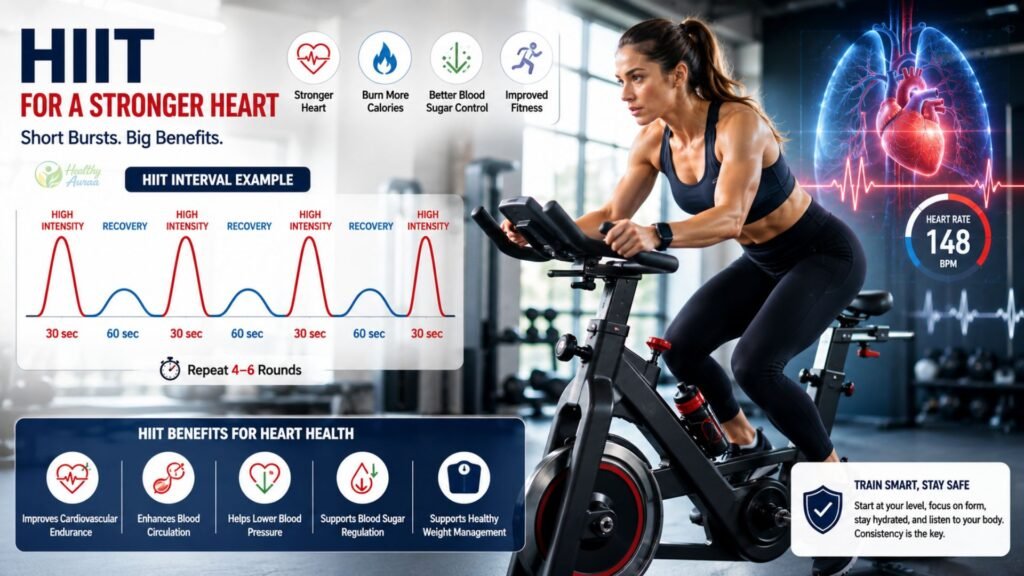
HIIT has earned attention because it can deliver a strong cardiovascular stimulus in a relatively short session. During high-intensity interval training, you alternate harder efforts with easier recovery periods. The exact structure can vary widely. A beginner might use brisk walking and faster walking rather than sprinting. An experienced athlete might use running, cycling or rowing intervals.
For people interested in HIIT for diabetes, the metabolic response is relevant but should not overshadow cardiovascular safety. Hard exercise can temporarily change glucose because hormones such as adrenaline and cortisol help mobilize stored fuel. That means HIIT and blood sugar can produce a more complicated short-term pattern than an easy walk. A temporary rise does not automatically mean the workout harmed your health.
Low-volume HIIT can be useful when time is limited. However, a shorter workout is not necessarily better for everyone. Beginners often gain more by establishing regular moderate-intensity exercise first. Once your fitness improves, intervals can become another tool rather than the entire toolbox.
The psychological side matters, too. Many people start an aggressive program because they believe harder exercise produces faster results. Then soreness, fatigue or fear of another difficult session breaks the habit. A moderate routine that you repeat for years can be far more valuable than an intense program that lasts three weeks. The best exercises for heart health should challenge you without making consistency feel impossible.
Does the Timing of Your Workout Affect Blood Sugar?
Exercise timing can influence how your workout fits into your day, although consistency generally matters more than chasing a perfect hour. Your best time to exercise is often the time when you can train safely and regularly. A morning session may work well for someone who becomes busy later. Another person may prefer afternoon exercise after work. Both can be sensible choices.
Meal timing adds another layer. Walking after eating can increase muscle activity when glucose from a meal is entering the bloodstream. Research has examined short periods of post-meal walking and other forms of post-meal exercise because muscle contractions can influence postprandial glucose, which means blood glucose after eating.
A 10-minute walk after eating can therefore be a practical habit for someone who wants to add movement without scheduling a full workout. The key is to view it as a supplement rather than a replacement for your weekly aerobic and strength routine. Walking after meals can also break up long periods of sitting, which is valuable in its own right.
The science around morning vs afternoon exercise remains more nuanced than many headlines suggest. Circadian rhythms can influence metabolism, temperature and exercise performance. Yet your personal schedule, sleep, fitness and ability to maintain the routine remain highly relevant. Instead of obsessing over exercise timing and blood sugar, build a schedule that you can follow consistently and adjust according to your goals and health needs.
How CGM Turns Exercise Research Into Personal Data
A continuous glucose monitor can provide a detailed picture of glucose changes throughout the day. For people who use a CGM for medical reasons, this can make exercise responses easier to observe. Instead of seeing only one fasting value, you may see how glucose changes before activity, during a workout and during recovery.
That can reveal useful glucose patterns. For example, some people may notice relatively stable glucose during walking but a different blood sugar response during vigorous exercise. Others may see different patterns after meals. These observations can help a person and their clinician understand how activity interacts with food, medication and daily routines.
Still, CGM data has limits. A sensor measures glucose in interstitial fluid rather than directly measuring blood at every moment. Readings can also lag behind rapidly changing blood glucose. Therefore, real-time glucose information should be interpreted within context rather than treated as an absolute score for whether a workout was good or bad.
For someone prescribed a CGM, CGM exercise tracking may help identify useful patterns such as post-exercise glucose, 24-hour glucose, or time in range. However, heart health cannot be judged from glucose alone. A lower glucose reading does not automatically mean a workout was cardiovascularly superior. Fitness, blood pressure, symptoms, recovery and long-term adherence all matter.
Using Glucose Data Without Losing Sight of Heart Health
The most useful personalized glucose data answers practical questions. How does your body respond to a walk after dinner? What happens after resistance training? Does vigorous exercise cause a temporary glucose spike? Do your readings return toward your usual range during recovery?
Those observations can complement medical care. They should not encourage you to chase the lowest possible glucose number. Your goal is healthier overall glucose control, not constant manipulation of a single reading. The same philosophy applies to exercise: seek sustainable improvements rather than dramatic short-term changes.
What’s the ‘Best’ Cardio Workout?
If you want a simple answer, start with brisk walking. It is inexpensive, accessible and easy to adjust. You can increase speed, walk uphill or extend the distance as your fitness improves. The NHLBI specifically recommends starting low and building slowly when you have been inactive.
Cycling provides another excellent option. It can raise your heart rate while reducing impact on the joints compared with running. Swimming offers a similar advantage for people who enjoy water-based exercise. Rowing, dancing, hiking and recreational sports can also qualify as endurance exercise when performed at an appropriate intensity.
Your choice should match your current ability. Someone with painful knees may find cycling or swimming more comfortable than running. Someone who dislikes gyms may enjoy outdoor walking. Someone who needs social motivation might prefer tennis or a group class. There is no prize for selecting the most fashionable workout.
The U.S. recommendations provide a useful target: adults should generally accumulate at least 150 to 300 minutes of moderate aerobic activity each week or 75 to 150 minutes of vigorous activity. Adults should also perform muscle-strengthening activity on at least two days each week.
How to Judge Exercise Intensity Without Fancy Equipment
You do not need laboratory equipment to estimate exercise intensity. During moderate activity, you should feel that your breathing and heart rate have clearly increased while still being able to speak. Vigorous exercise makes conversation much harder.
This simple test can help you avoid another common mistake. People sometimes assume every workout must leave them exhausted. It does not. Low-intensity exercise has a place in an active lifestyle, especially for recovery, beginners and people managing physical limitations.
How to Get the Most Out of Home Workouts
A strong cardiovascular routine does not require an expensive gym membership. Your home can become a useful training environment with walking, stair climbing, bodyweight exercises, resistance bands or dumbbells. You can combine a few minutes of aerobic movement with simple strength exercises and gradually increase the challenge.
For example, you might walk briskly around your neighborhood before performing squats, wall push-ups and resistance-band rows at home. Another day could involve cycling followed by light strength work. This approach develops both cardiovascular fitness and muscular capacity without requiring complicated equipment.
The biggest advantage of a home routine is convenience. The biggest disadvantage is that convenience can disappear when the workout has no structure. Set a regular time, keep equipment visible and choose movements you can perform confidently. Sustainable exercise depends less on motivation than on reducing the friction between deciding to exercise and actually starting.
Recent research also supports a flexible view of weekly activity. An American Heart Association report covering a large observational study found that people who accumulated about 150 minutes of moderate-to-vigorous activity over one or two days had similar associations with lower mortality risk compared with people who spread activity across the week. However, spreading activity may feel easier on your body and can help you avoid long inactive periods.
Safety Considerations and Injury Prevention
Safety begins with knowing your starting point. If you have been inactive for months or years, jumping immediately into hard running or heavy lifting is unnecessary. Moderate aerobic activity such as walking can provide a sensible starting point. Increase duration first. Then gradually add speed, resistance or hills as your fitness improves.
People with known cardiovascular disease, significant symptoms or other chronic conditions should discuss exercise plans with a healthcare professional. Mayo Clinic’s current guidance emphasizes that people with chronic conditions can benefit from exercise but may need individualized advice about which activities and intensity levels are appropriate.
Pay attention to warning symptoms. Chest pressure or pain, fainting, unusual severe breathlessness or other concerning symptoms during exercise deserve prompt medical evaluation. Do not assume that pushing through symptoms will make you fitter. Your workout should create a training stimulus, not a medical emergency.
Recovery matters as much as effort. Sleep, hydration, nutrition and rest all influence how well you adapt to training. If every session leaves you exhausted, reduce the intensity or volume. The long game wins here. The best exercises for heart health are those that improve fitness while allowing you to keep showing up.
Frequently Asked Questions
What are the best exercises for heart health?
The best exercises for heart health usually include aerobic activities such as brisk walking, cycling, swimming, jogging or dancing alongside resistance training. Aerobic exercise directly improves cardiorespiratory fitness. Strength work supports muscle, function and body composition. Johns Hopkins recommends combining both for a balanced program.
Is walking enough for heart health?
Walking can be an excellent foundation. Brisk walking raises your heart rate and contributes toward weekly aerobic activity targets. If you are currently inactive, walking may be the easiest way to establish a routine. Over time, you can increase distance, speed or incline or add cycling and strength work.
How much exercise should you get each week?
For most adults, U.S. guidelines recommend 150 to 300 minutes of moderate aerobic activity weekly or 75 to 150 minutes of vigorous activity. You should also perform muscle-strengthening activities on at least two days each week. If you currently do little exercise, start with smaller amounts and build gradually.
Is strength training good for your heart?
Yes. Strength training supports cardiovascular health by improving muscle strength and body composition. The American Heart Association considers resistance exercise a safe and effective component of cardiovascular disease prevention and management for many adults.
Is HIIT better than walking?
Not necessarily. HIIT can improve fitness efficiently, but it demands greater effort. Walking is easier to perform frequently and can be an excellent foundation. Your choice should reflect your current fitness, medical status and ability to recover. For many people, a combination provides the most practical approach.
Can exercise help with diabetes and heart disease risk?
Yes. Regular physical activity and diabetes management often overlap because exercise can improve glucose regulation while also supporting blood pressure, weight and cardiovascular fitness. The NHLBI notes that physical activity helps manage blood sugar and insulin levels and lowers the risk of type 2 diabetes.
Does exercise improve HbA1c?
Regular activity can contribute to better long-term glucose management and can support exercise and HbA1c improvements in people with diabetes. However, HbA1c reflects average glucose over time and is influenced by medication, nutrition, illness and other factors. Exercise should therefore form part of a broader diabetes management plan rather than act as a standalone treatment.
What happens to blood sugar during intense exercise?
Hard exercise can sometimes cause a temporary increase in glucose because adrenaline and other stress hormones encourage the liver to release stored fuel. The response varies between people and depends on exercise intensity, duration, fitness, food intake and medication. A temporary glucose spike does not necessarily mean the workout was harmful.
Should you exercise after meals?
For many people, gentle exercise after meals can be a practical way to add movement and may help moderate post-meal glucose. Postprandial exercise has been studied because muscle activity can increase glucose use after eating. If you use glucose-lowering medication, however, discuss exercise and possible hypoglycemia with your healthcare professional.
What is the best time to exercise?
There is no universal winner. The best time to exercise is generally the time that fits your schedule and allows you to train consistently and safely. Morning exercise may suit some people, while others perform better during the afternoon or evening. Your overall weekly activity pattern matters more than chasing a perfect clock time.
A Practical Heart-Health Exercise Framework
| Goal | Practical approach |
| Improve cardiovascular fitness | Build toward 150–300 minutes of moderate aerobic activity each week |
| Improve strength | Train major muscle groups at least twice weekly |
| Start after inactivity | Begin with comfortable walking and increase gradually |
| Add intensity | Introduce faster intervals after establishing a fitness base |
| Support metabolic health | Combine aerobic activity with resistance training |
| Reduce prolonged sitting | Break up long sedentary periods with movement |
| Improve adherence | Choose activities you enjoy and can repeat |
| Exercise with a chronic condition | Ask your healthcare professional about appropriate intensity |
The Bottom Line
The search for one perfect workout misses the bigger picture. Your cardiovascular system responds to regular movement, not marketing labels. Walking can build your foundation. Cycling and swimming can develop endurance. Resistance training can strengthen your body. Carefully selected intervals can add intensity when you are ready.
The most effective best exercises for heart health are therefore the ones that fit your body, schedule and current fitness level. Build gradually. Combine aerobic and strength work. Sit less. Recover well. Most importantly, make the routine sustainable enough that you can still follow it months and years from now.
Heart health also reaches beyond exercise. Healthy nutrition, adequate sleep, tobacco avoidance, blood-pressure management, cholesterol control and appropriate medical care all contribute to cardiovascular risk reduction. Exercise is one powerful piece of that larger picture.
Medical Disclaimer
This article provides general educational information and is not a substitute for individualized medical advice. If you have heart disease, diabetes, uncontrolled hypertension, significant symptoms or another chronic condition, speak with a qualified healthcare professional before beginning or substantially changing an exercise program.
Trusted Sources
National Heart, Lung, and Blood Institute — Physical Activity and Your Heart
National Heart, Lung, and Blood Institute — Benefits of Physical Activity
Johns Hopkins Medicine — Physical Activity for Heart Health
American Heart Association — Physical Activity Guidelines
American Heart Association — Resistance Exercise Training Scientific Statement