
How Many Calories Should I Eat to Lose Weight? The Complete Guide to Daily Calorie Needs
Walking is one of the easiest ways to improve your health. You do not need expensive equipment or a gym membership to get started. A comfortable pair of shoes and a little time each day are enough. Many people ask, how many calories does walking 10,000 steps burn because they want to understand how daily movement supports weight loss and overall fitness.
The answer is not the same for everyone. Your body weight, walking speed, walking terrain, exercise intensity, and even your metabolic rate affect the number of calories your body uses. Most adults burn between 250 and 500 calories after completing 10,000 steps. However, the number is only an estimate because every person’s body works differently.
Walking is much more than a way to burn calories. It improves heart health, supports mental health, strengthens muscles and bones, and lowers the risk of many chronic diseases. According to the Centers for Disease Control and Prevention (CDC), regular physical activity such as walking helps adults stay healthier throughout life. Research from Harvard Health and Mayo Clinic also shows that a consistent walking habit supports better energy levels, improved sleep, and long-term weight management.
If your goal is to lose weight, improve fitness, or simply become more active, this guide explains everything you need to know. You will learn how many calories 10,000 steps burn, what affects your calorie expenditure, how to estimate your own results, and how to make every walk more effective.
Key Takeaways
Walking 10,000 steps burns approximately 250 to 500 calories for most adults. Your body weight, walking pace, walking distance, and exercise duration all influence the final number. A brisk walk usually burns more calories than slow walking because your muscles work harder.
Walking every day also supports walking and weight management, improves cardiovascular fitness, increases endurance, strengthens bones, and promotes better overall wellness. Combined with healthy eating, a regular walking routine can become one of the most sustainable ways to maintain a healthy lifestyle.
How Many Calories Does Walking 10,000 Steps Burn?
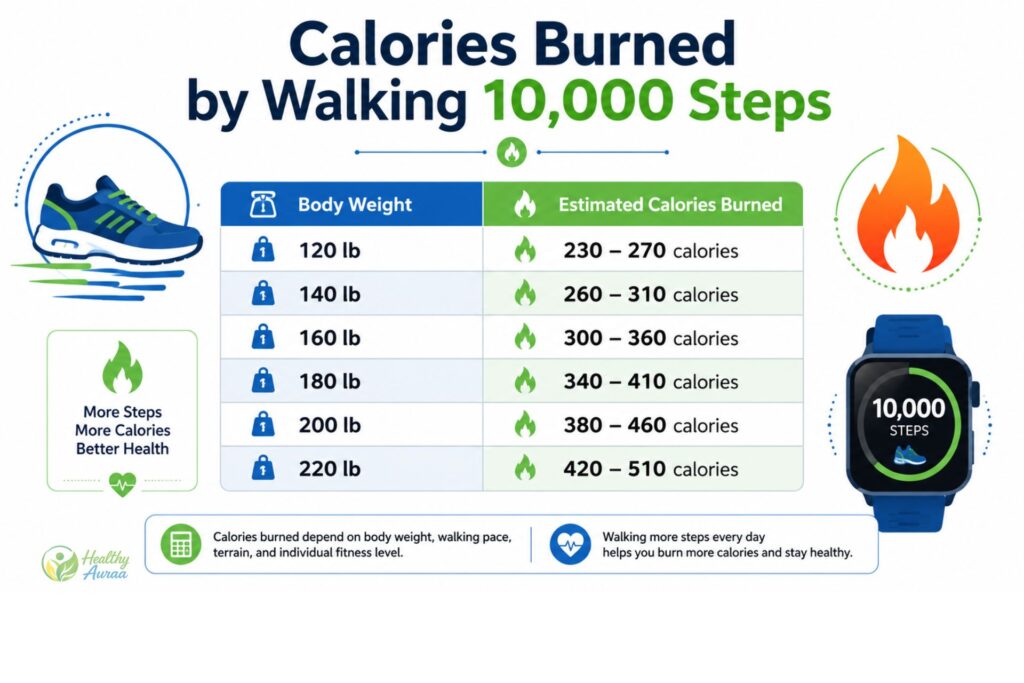
Many people search for how many calories does 10000 steps burn because they want a simple way to measure progress. On average, walking 10,000 steps burns between 250 and 500 calories. The exact amount depends on how much you weigh, how fast you walk, and the distance you cover. Someone weighing 120 pounds burns fewer calories than someone weighing 220 pounds because moving a larger body requires more energy.
Your walking style also matters. A slow walk on flat pavement uses less energy than a brisk walk on hills. Wind, temperature, and even carrying a backpack increase energy expenditure. That is why two people who complete the same step count may see different numbers on their fitness trackers.
Average Calories Burned by Body Weight
| Body Weight | Estimated Calories Burned | Approximate Distance |
| 120 lb (54 kg) | 230–270 | 5 miles |
| 140 lb (64 kg) | 260–310 | 5 miles |
| 160 lb (73 kg) | 300–360 | 5 miles |
| 180 lb (82 kg) | 340–410 | 5 miles |
| 200 lb (91 kg) | 380–460 | 5 miles |
| 220 lb (100 kg) | 420–510 | 5 miles |
These numbers are estimates rather than exact measurements. Your actual calories burned walking 10,000 steps may vary because every body uses energy differently.
Fact: Most adults cover about walking 5 miles or approximately 8 kilometers when they complete 10k steps.
How Walking Burns Calories
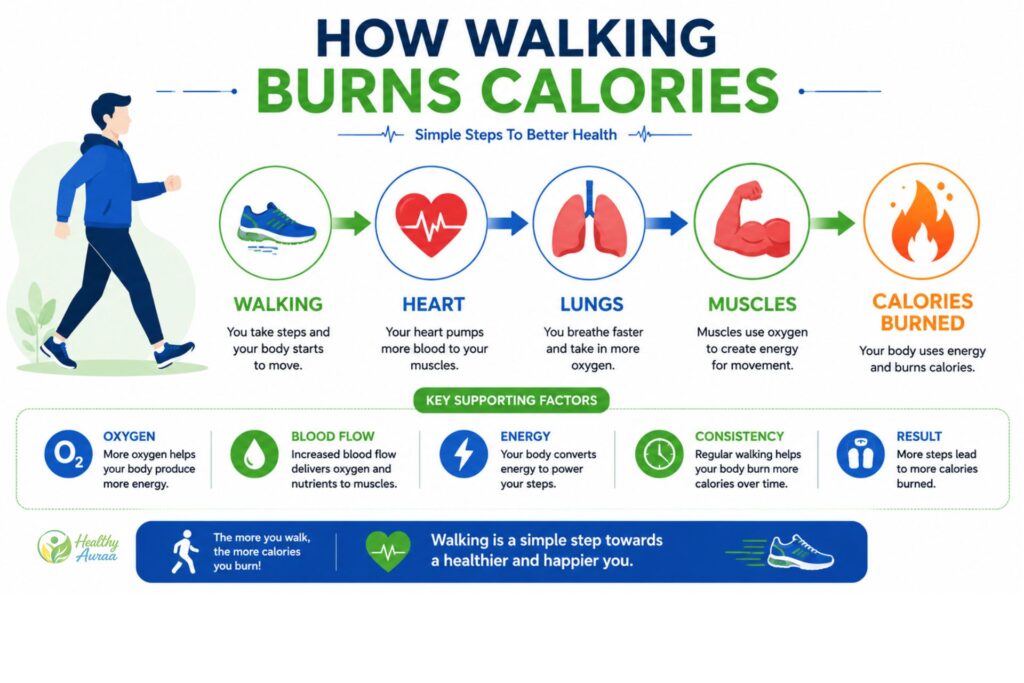
Walking looks simple, yet many systems inside your body work together every second you move. Your heart pumps oxygen-rich blood to your muscles. Your lungs supply oxygen while your muscles convert stored carbohydrates and fat into usable energy. This process creates exercise calories, increases energy burned, and supports your body’s natural metabolic health.
Every step activates your calves, hamstrings, quadriceps, glutes, hips, and core muscles. Swinging your arms naturally recruits even more muscles, which slightly increases calorie expenditure. Walking uphill demands additional effort because gravity makes your muscles work harder. Even downhill walking requires muscle control to stabilize your joints.
How Your Body Uses Energy While Walking
| Body System | What Happens |
| Heart | Pumps more oxygen-rich blood |
| Lungs | Deliver oxygen to working muscles |
| Muscles | Burn fat and carbohydrates for energy |
| Brain | Improves coordination and balance |
| Metabolism | Increases overall daily calorie burn |
Health experts often describe walking as one of the safest forms of aerobic exercise because it improves fitness while placing relatively little stress on the joints.
Quote: “Walking is man’s best medicine.” — Hippocrates
Factors That Affect Calories Burned
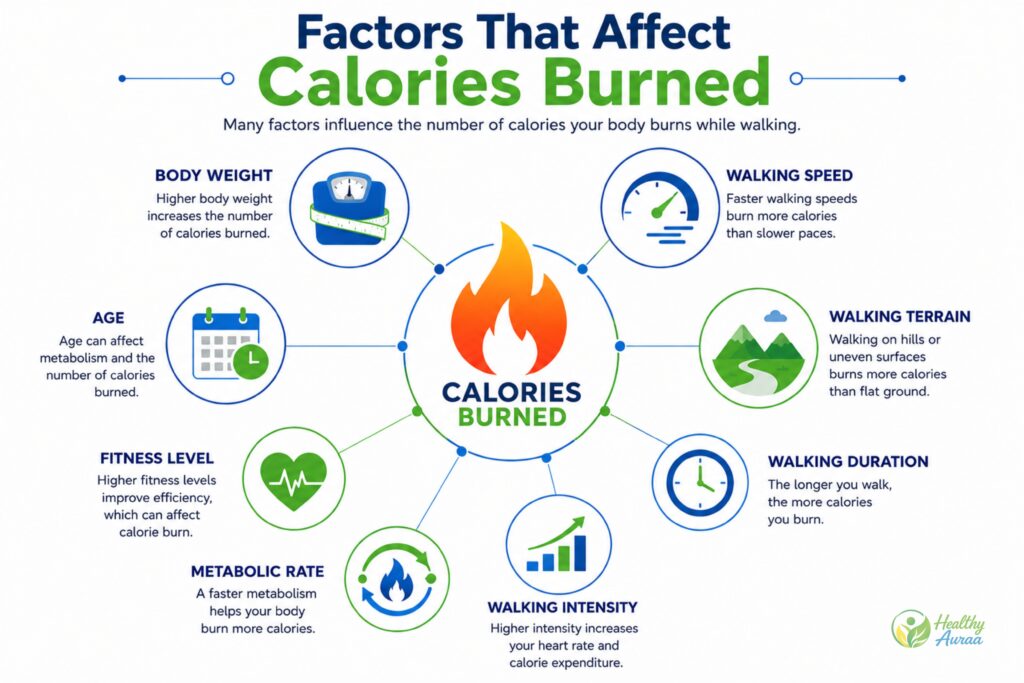
No two people burn exactly the same number of calories during a walk. Several important factors influence your personal calorie estimate. Understanding these variables helps you set realistic expectations and track progress more accurately.
The biggest factor is body weight. Heavier individuals generally burn more calories because they move more mass with every step. Walking speed also changes the amount of energy used. A leisurely stroll burns fewer calories than a fast-paced walk. Likewise, walking terrain plays an important role. Flat sidewalks require less effort than hills, trails, or uneven ground.
Your natural body size, age, fitness level, and genetics all influence your metabolic rate. As you become fitter, your body performs the same activity more efficiently. Although this improves endurance, it may slightly reduce calorie use during identical walks. This is a normal adaptation and should not discourage you from maintaining a regular walking program.
Main Factors That Influence Calorie Burn
| Factor | Effect on Calories Burned |
| Body weight | Higher weight usually burns more calories |
| Walking speed | Faster pace increases calorie burn |
| Walking intensity | Brisk walking uses more energy |
| Walking terrain | Hills increase effort |
| Exercise duration | Longer walks burn more calories |
| Muscle activity | Greater muscle use raises energy needs |
| Exercise efficiency | Improved fitness may reduce calories slightly |
| MET value | Higher MET values indicate greater energy use |
The MET value, or metabolic equivalent, measures how much energy an activity requires compared with resting. Walking at different speeds has different MET values, making it useful when estimating calories with a walking calorie calculator or exercise calculator.
Calories Burned by Walking 10,000 Steps by Body Weight
Your weight is one of the strongest predictors of calories burned by walking. Larger individuals naturally require more energy to move because their muscles perform more work with every step. This explains why two people walking the same distance often receive different readings from a step tracker.
The table below provides realistic estimates for adults walking approximately five miles at a moderate pace. These values are averages and should be used as guidance rather than exact numbers. Fitness watches and online calorie calculator tools can provide more personalized estimates by considering additional factors such as heart rate, age, and sex.
| Weight (Pounds) | Weight (Kilograms) | Estimated Calories Burned |
| 110 | 50 | 210–250 |
| 130 | 59 | 240–290 |
| 150 | 68 | 280–340 |
| 170 | 77 | 320–390 |
| 190 | 86 | 360–440 |
| 210 | 95 | 400–490 |
| 230 | 104 | 440–540 |
| 250 | 113 | 480–590 |
If you prefer pounds to kilograms, divide your weight in pounds by 2.205 to estimate your weight in kilograms. Many fitness apps use metric units when calculating exercise calories, making this conversion useful.
Case Study
Sarah weighs 160 pounds and walks 10k steps five days each week at a brisk pace. She burns roughly 330 calories per walk. Over one month, she burns nearly 6,600 calories through walking alone. Combined with healthy eating and a moderate calorie deficit, this consistent habit supports gradual fat loss, improved body composition, and better long-term walking for fitness results without extreme workouts.
Calories Burned for Different Step Counts
Not everyone reaches 10,000 steps every day, and that is perfectly okay. Any increase in your daily movement helps your body become healthier over time. As your step count grows, your daily calorie burn also increases. Even walking 4,000 or 6,000 steps can improve cardiovascular fitness, support overall wellness, and move you closer to a more active lifestyle.
The number of calories you burn depends on more than just the number of steps. Your body weight, walking speed, walking intensity, and walking terrain all influence your energy expenditure. Someone walking quickly on a hilly trail will usually burn more calories than someone taking the same number of steps on a flat sidewalk.
Estimated Calories Burned by Step Count
| Steps Per Day | Approximate Distance | Estimated Calories Burned |
| 2,000 | 1 mile | 80–100 |
| 4,000 | 2 miles | 120–180 |
| 6,000 | 3 miles | 170–270 |
| 8,000 | 4 miles | 220–380 |
| 10,000 | 5 miles | 250–500 |
| 12,000 | 6 miles | 320–600 |
| 15,000 | 7.5 miles | 400–750 |
These estimates provide a helpful guideline, but your actual calorie expenditure may be higher or lower depending on your fitness level and the conditions of your walk.
How to Estimate Calories Burned from Your Steps
Estimating the number of calories you burn while walking does not have to be complicated. Most people can get a reliable estimate by combining their walking distance, body weight, and walking pace. Since how many miles is 10,000 steps is usually around five miles, calculating your calories becomes much easier.
A general rule is that most adults burn around 80 to 100 calories per mile while walking at a moderate pace. Fitness watches and online tools improve this estimate by considering additional information such as age, height, heart rate, and exercise duration. Although no method is perfectly accurate, tracking your progress over several weeks gives you a much clearer picture than focusing on a single day’s numbers.
Simple Formula to Estimate Calories Burned
Calories Burned = Calories Per Mile × Miles Walked
For example, if you burn approximately 90 calories per mile and walk five miles, your total calorie burn would be close to 450 calories.
Ways to Estimate Your Calories More Accurately
| Method | Accuracy | Best For |
| Basic formula | Good | Quick estimates |
| Walking calorie calculator | Very Good | Daily tracking |
| Fitness smartwatch | Very Good | Real-time monitoring |
| MET calculator for walking | Excellent | Detailed fitness planning |
Using a walking calorie calculator regularly helps you understand trends over time instead of worrying about exact daily numbers.
10,000 Steps in Miles and Kilometers
Many people know the goal of 10,000 steps, but fewer know the distance it represents. For the average adult, 10k steps equals approximately walking 5 miles or around 8 kilometers. However, the exact distance depends on your height and natural stride length.
People with longer legs usually take fewer steps to cover the same distance, while shorter individuals may need slightly more steps. This difference also explains why calories per step vary from person to person. Knowing your distance instead of only your step count gives you a better understanding of your daily activity level.
Step Count to Distance Conversion
| Steps | Miles | Kilometers |
| 2,000 | 1 | 1.6 |
| 4,000 | 2 | 3.2 |
| 6,000 | 3 | 4.8 |
| 8,000 | 4 | 6.4 |
| 10,000 | 5 | 8 kilometers |
| 12,000 | 6 | 9.6 |
| 15,000 | 7.5 | 12 |
Understanding your walking distance makes it easier to estimate calories burned walking and compare your activity from one day to the next.
How Long Does It Take to Walk 10,000 Steps?
The time needed to complete 10,000 steps depends on your walking pace. Most adults finish this distance in about 75 to 120 minutes. The good news is that you do not have to walk all those steps at once. Short walks throughout the day provide similar health benefits and make the goal much easier to achieve.
Many people find success by creating a simple walking schedule. A short morning walk, a lunchtime stroll, and an evening walk after dinner can easily add up to 10,000 steps. This approach fits naturally into a busy lifestyle while helping you stay consistent with your walking routine.
Average Time Required for 10,000 Steps
| Walking Pace | Speed | Time Needed |
| Slow | 2 mph | 110–130 minutes |
| Moderate | 3 mph | 90–110 minutes |
| Brisk walk | 4 mph | 70–90 minutes |
| Fast | 4.5+ mph | 60–75 minutes |
If you are just starting a walking exercise for beginners, begin with 20 to 30 minutes each day and gradually increase your walking time. Building your fitness step by step is more effective than trying to reach 10,000 steps on your first day. Consistency is what leads to better endurance, stronger joint health, and long-term success.
Can You Lose Weight by Walking 10,000 Steps a Day?
Walking 10,000 steps every day can absolutely help you lose weight, but it is not a magic solution on its own. The key to successful weight loss is creating a calorie deficit, which means your body burns more calories than you consume. Walking increases your daily calorie burn, making it easier to achieve that deficit without relying on extreme diets or exhausting workouts.
When combined with healthy eating, regular sleep, and strength training, walking becomes a powerful tool for long-term weight management. Instead of focusing only on the number on the scale, pay attention to improvements in your body composition, energy levels, and overall fitness. Consistency matters much more than perfection, and even small daily habits can produce significant results over time.
How Walking Supports Weight Loss
| Healthy Habit | Benefit |
| Walking 10,000 steps daily | Increases calorie expenditure |
| Eating a balanced diet | Helps maintain a calorie deficit |
| Strength training | Preserves muscle while promoting fat loss |
| Drinking enough water | Supports metabolism and recovery |
| Getting quality sleep | Helps regulate hunger hormones |
A person who burns around 350 calories by walking 10,000 steps five days each week can create a meaningful calorie deficit over time. Combined with healthy nutrition, this habit can lead to gradual and sustainable weight loss.
Fact: According to the CDC, losing 1–2 pounds per week is considered a safe and healthy rate of weight loss.
Health Benefits of Walking 10,000 Steps Daily
Walking every day offers far more than just calorie burning. A consistent walking routine strengthens your heart, improves your mood, boosts your energy, and lowers the risk of many chronic diseases. It is one of the simplest forms of physical activity, yet it delivers benefits that affect almost every part of your body.
Research from trusted organizations such as the CDC, Harvard Health, and Mayo Clinic shows that daily walking supports heart health, improves brain function, enhances mental health, and helps maintain healthy blood sugar levels by improving insulin sensitivity. Because walking is a low-impact exercise, it is also gentle on the joints while supporting stronger bones and muscles.
Major Health Benefits of Walking Every Day
| Health Benefit | How Walking Helps |
| Heart health | Improves circulation and lowers blood pressure |
| Mental health | Reduces stress and anxiety |
| Brain function | Supports memory and concentration |
| Bone health | Strengthens bones through weight-bearing movement |
| Joint health | Keeps joints flexible and reduces stiffness |
| Metabolic health | Improves blood sugar control |
| Overall wellness | Supports healthy aging |
| Chronic disease prevention | Lowers the risk of heart disease and type 2 diabetes |
Walking is also an excellent way to reduce long periods of sitting. Simply adding more movement throughout your day contributes to better health and supports a more active lifestyle.
How to Burn More Calories While Walking
If your goal is to burn more calories without walking much farther, making small changes to your routine can have a big impact. Increasing your walking speed is one of the easiest ways to raise your energy expenditure. A brisk walk requires your muscles to work harder, which naturally increases the number of calories you burn.
Walking uphill is another effective strategy. Uphill walking activates your glutes, calves, and leg muscles more than walking on flat ground. You can also include short bursts of faster walking, known as interval walking, to increase exercise intensity while keeping your workout enjoyable. These simple adjustments make your walking sessions more efficient without adding much extra time.
Easy Ways to Burn More Calories
| Strategy | Benefit |
| Increase walking speed | Burns more calories in less time |
| Try uphill walking | Increases muscle activity |
| Walk for longer periods | Raises total calorie burn |
| Add interval walking | Improves cardiovascular fitness |
| Swing your arms naturally | Engages more muscles |
| Maintain good posture | Improves exercise efficiency |
Remember that consistency always beats intensity. Walking at a moderate pace several times each week delivers better long-term results than doing one extremely difficult workout and then taking several days off.
Walking Outdoors vs Treadmill: Which Burns More Calories?
Both outdoor walking and treadmill walking are excellent forms of walking exercise, and each has its own advantages. Walking outdoors often burns slightly more calories because your body must adapt to changing walking terrain, wind resistance, hills, and uneven surfaces. These natural challenges require additional muscle activity and increase your overall energy burned.
A treadmill, on the other hand, offers a controlled environment where you can easily adjust your speed and incline. This makes it an excellent choice during bad weather or when you want to follow a structured exercise program. Adding a slight incline can closely match the effort required for outdoor walking while allowing you to maintain a steady pace.
Outdoor Walking vs. Treadmill Walking
| Feature | Outdoor Walking | Treadmill Walking |
| Terrain | Natural and varied | Flat or adjustable incline |
| Weather | Depends on conditions | Always comfortable indoors |
| Calorie Burn | Slightly higher in many cases | Similar with incline |
| Pace Control | Less consistent | Easy to control |
| Convenience | Requires safe walking routes | Available anytime |
The best option is the one you enjoy enough to do regularly. Whether you choose a local park or a treadmill at the gym, staying consistent with your walking workout is what truly improves your fitness and supports long-term health.
How to Reach 10,000 Steps Every Day
Reaching 10k steps each day may sound challenging at first, but it becomes much easier when you spread your movement throughout the day. Instead of trying to complete one long walk, look for opportunities to stay active during your normal routine. Short walks after meals, taking the stairs, parking farther away, and walking during phone calls can quickly increase your step count without disrupting your schedule.
The goal is to create a sustainable walking routine rather than forcing yourself through long workouts every day. As walking becomes a habit, you will naturally become more active and find it easier to achieve your daily step goal. Even if you fall short occasionally, staying consistent over weeks and months delivers far greater results than aiming for perfection every single day.
Simple Ways to Reach 10,000 Steps
| Daily Activity | Average Steps |
| Morning 20-minute walk | 2,500 |
| Walk after lunch | 1,500 |
| Walking during phone calls | 1,000 |
| Household chores | 1,200 |
| Grocery shopping | 800 |
| Evening 30-minute walk | 3,000 |
| Total Daily Steps | 10,000 |
If you struggle to stay motivated, use a step tracker or fitness app to monitor your progress. Seeing your steps increase throughout the day can encourage you to stay active and maintain a healthy walking schedule.
Common Mistakes That Reduce Your Calorie Burn
Many people walk every day but still do not get the results they expect. Often, simple habits reduce the number of calories burned without them realizing it. Walking too slowly, wearing uncomfortable shoes, or following the same route every day can all reduce your overall calorie expenditure.
Another common mistake is relying only on walking while ignoring other healthy habits. Walking works best when combined with balanced nutrition, proper hydration, strength training, and quality sleep. Improving your exercise intensity from time to time by adding hills or increasing your walking speed can also help your body continue making progress.
Mistakes to Avoid
| Common Mistake | Better Alternative |
| Walking too slowly | Maintain a brisk walk |
| Poor posture | Walk tall with relaxed shoulders |
| Wearing worn-out shoes | Choose supportive walking shoes |
| Skipping rest and hydration | Allow proper recovery |
| Walking the same route daily | Add variety with different walking terrain |
| Ignoring nutrition | Support walking with healthy eating |
Making these small adjustments can improve your exercise efficiency, increase your daily calorie burn, and help you enjoy better long-term results.
Frequently Asked Questions
How many calories does 10000 steps burn?
Most adults burn between 250 and 500 calories after walking 10,000 steps. The exact number depends on body weight, walking speed, walking intensity, walking terrain, and your overall fitness level.
Does walking 10,000 steps help lose weight?
Yes. Walking 10,000 steps for weight loss can be very effective when combined with a healthy diet that creates a calorie deficit. Consistency is the key to achieving long-term success.
How many miles is 10,000 steps?
For most adults, how many miles is 10,000 steps equals approximately walking 5 miles, which is about 8 kilometers. Your stride length may slightly increase or decrease this distance.
What is the best walking speed for burning calories?
A brisk walk at around 3.5 to 4 miles per hour generally burns more calories than a slow walk because it increases exercise intensity and overall energy expenditure.
Can beginners walk 10,000 steps?
Yes, but beginners should increase their activity gradually. Start with a smaller daily step goal, then add more steps each week until reaching 10,000 comfortably.
Is a walking calorie calculator accurate?
A walking calorie calculator provides a good estimate by using factors such as your body mass, age, MET value, heart rate, and exercise duration. While it may not be perfectly accurate, it is useful for tracking long-term progress.
Final Thoughts
If you have been wondering how many calories does 10000 steps burn, the answer depends on several personal factors. Most people burn between 250 and 500 calories, but your body weight, walking speed, walking terrain, and metabolic rate all influence the final result. Instead of focusing on an exact number, use these estimates as a guide while tracking your overall progress.
Walking is one of the simplest ways to improve your health because it supports much more than weight loss. The benefits of walking 10,000 steps include better heart health, stronger muscles and bones, improved mental health, enhanced brain function, and greater overall wellness. It also helps with walking and weight management, increases cardiovascular fitness, and supports long-term chronic disease prevention.
The most important step is simply getting started. Build a consistent walking program, stay active every day, and make walking part of your healthy lifestyle. Whether your goal is walking for fitness, improving endurance, or achieving a healthier body, every step you take brings you closer to better health.
References
The information in this article is based on evidence from trusted health organizations.
- Centers for Disease Control and Prevention (CDC): https://www.cdc.gov/physicalactivity/
- National Institutes of Health (NIH): https://www.nih.gov/
- Harvard Health Publishing: https://www.health.harvard.edu/
- Mayo Clinic: https://www.mayoclinic.org/
- Cleveland Clinic: https://health.clevelandclinic.org/
- Johns Hopkins Medicine: https://www.hopkinsmedicine.org/
- American Heart Association: https://www.heart.org/
Medical Disclaimer: This article is for educational purposes only. It should not replace professional medical advice, diagnosis, or treatment. Always consult a qualified healthcare provider before starting a new exercise program or making significant lifestyle changes.